


Imagine standing in line at the grocery store. There’s nothing wrong, no threat, no deadline, no bad news. Still, your heart pounds as if you just ran up several flights of stairs. Your stomach feels tight and your hands are cold.
You remind yourself: I’m fine. I’m safe. There’s nothing to worry about.
But your body doesn’t seem to get the message.
This is the frustrating reality of anxiety. Most people who deal with it aren’t confused about the facts. They know flying is safer than driving to the airport. They know a meeting isn’t life or death. They know the grocery store is just a grocery store. The problem isn’t what they know.
The real issue is that your mind and your nervous system learn in different ways. That’s why simply reassuring yourself often doesn’t help.
Here’s a sentence I’ve heard hundreds of times from clients: “I know it’s irrational, but I still feel it.”
That sentence sums up the problem. Your thinking mind has already done its job. It has reviewed the evidence, run the numbers, and reached a verdict: no danger here. But your nervous system isn’t convinced.
This is how you’re wired and knowing that can change how you deal with anxiety.
Your nervous system learns through experience. Words alone rarely change how you feel. Logic can change your thoughts, but experience changes how you respond.
Think about your phone’s GPS. If it detects heavy traffic on your usual route, it keeps rerouting you until it receives new information. You can tell it the road is clear, but it won’t believe you just because you said so. It changes when it gathers enough new evidence.
Your nervous system works the same way. It doesn’t update because you reassure yourself. It updates because repeated experiences teach it something new.
Fear Is Learned. Safety Can Be Learned Too.
A lot of this learning happens in a small part of your brain called the amygdala. It often gets a bad reputation, but its job is surprisingly simple. It’s constantly scanning for danger and asking one question:
“Am I safe?”
To answer that question, the amygdala doesn’t rely on logic. It relies on experience.

If you’ve had a frightening experience in an elevator, while driving on the freeway, speaking in public, or even walking into a crowded store, your brain remembers more than the event itself. It remembers the context. The next time you find yourself in a similar situation, your amygdala doesn’t stop to investigate whether today’s circumstances are different. It makes a prediction based on past events and prepares your body for danger.
In other words, it’s not reacting to what’s happening right now. It’s reacting to what it expects could happen.
That’s why just telling yourself, “I’m safe,” often doesn’t help. You’re trying to reason with a system that doesn’t use logic. It’s like a smoke detector that’s become too sensitive after a real fire. Even though it’s frustrating, it’s only trying to protect you.
The encouraging part is that these predictions aren’t permanent. They’re constantly being updated by new experiences. Every time you stay in the situation long enough to discover that nothing bad happens, every time your body settles instead of escaping, your nervous system gathers new evidence.
The opposite happens too. If you leave a situation before your brain has a chance to discover there’s no real danger, it gets a different message: “Good thing we left. That must have been dangerous.” Avoiding things might feel better for a moment, but it makes the fear stronger next time.
Recovery starts when your nervous system no longer treats every wave of anxiety as a sign you’re in danger.
Fear is learned.
And because it’s learned, safety can be learned too.
So how can you give yourself the experiences you need to learn to feel calm rather than fear?
Three Ways to Teach Your Brain That You’re Safe
This is the heart of what I talk about, so let’s get specific. There are three main ways to make real progress, and each one works by giving your nervous system new evidence, not just new arguments.
1. Give Yourself New Experiences
One of the best ways to calm your nervous system is to slowly return to the situations you’ve been avoiding and realize you’re actually okay.
This doesn’t mean you should jump straight into your biggest fear and hope it works out. That can actually make things worse. Instead, take small, steady steps that challenge you but don’t overwhelm you. Stay in the grocery store a couple of minutes longer than usual. Go to that party. Speak up once in a meeting instead of staying quiet.
Each small step becomes another piece of evidence. Every time you face something you’ve been avoiding and realize you’re okay, your amygdala learns that the situation isn’t as dangerous as it expected. The more proof it gets, the less it sounds the alarm.
2. Calm the Body
Your nervous system pays attention to your body before it listens to your thoughts.
To your brain, a racing heart and tight chest feel just like real danger. It doesn’t matter if the threat is only in your mind.
Your body can’t tell the difference between a bear and a stressful email.
That’s why calming your body with your breath often works better than trying to think your way to calm.
Try exhaling more slowly than you inhale. Splash cold water on your face or wrists. Put both feet on the ground and name five things you see. Spend ten minutes outside. These aren’t just tricks, they send your body a clear signal that helps override the alarm. As your body settles, your brain quietly updates its sense of safety. Calming your body often works faster than calming your mind.
3. Update Old Emotional Memories
Some of the alarms you feel today aren’t really about today. They’re old memories, sometimes from years or decades ago, still running in the background like outdated software.
These old experiences taught you, “I’m not safe here.” Maybe it was one event, or maybe it happened so often it became your default. Either way, these memories affect you whenever something similar happens.
Over the years, I’ve tried many ways to deal with anxiety. The two I use most are hypnosis and EFT because they align with how the nervous system really learns. They don’t just try to reassure you with words. They help you have a different emotional response.
With time, the strong feelings tied to those old memories start to fade. This lets you respond more calmly and flexibly, instead of always sounding the alarm.
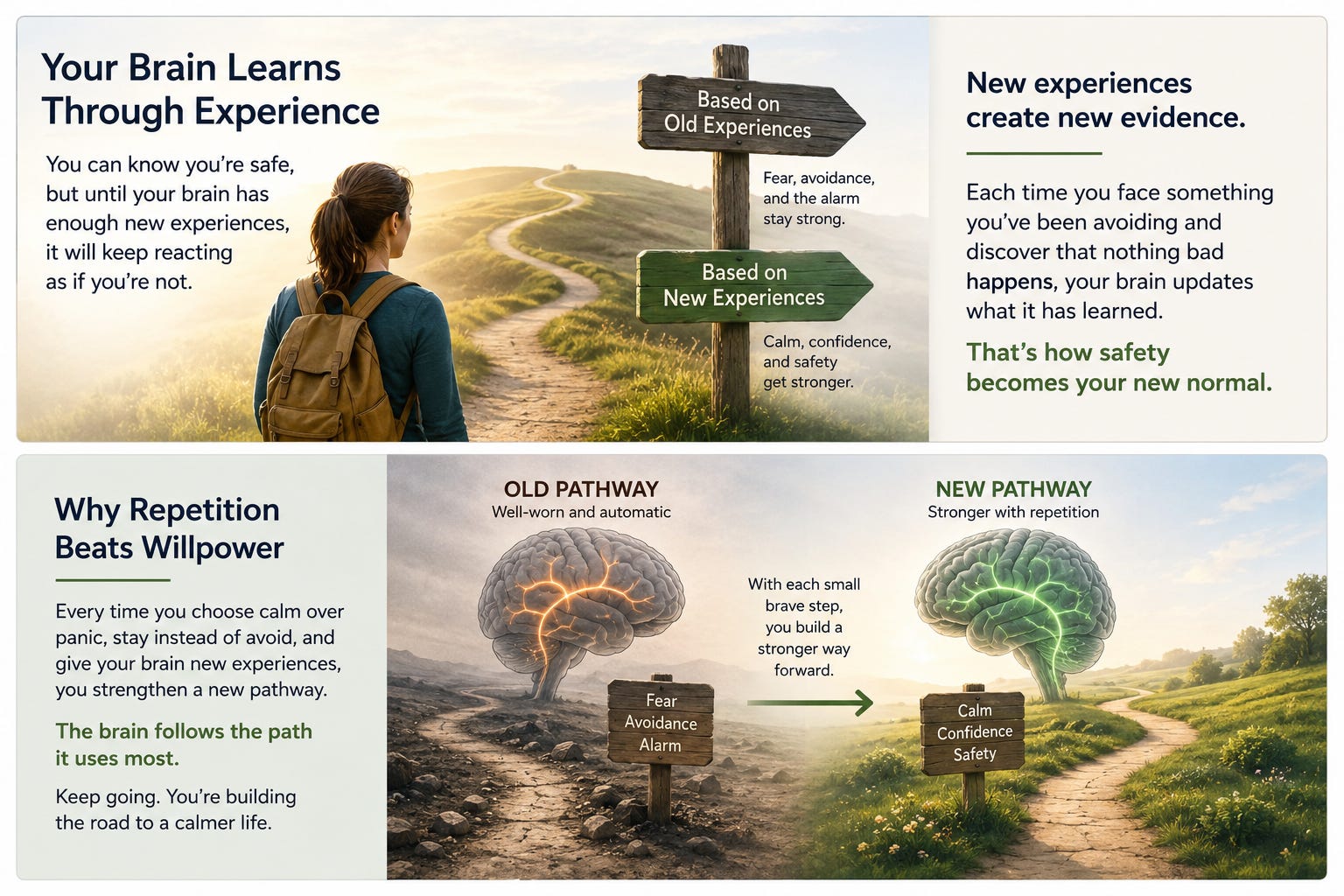
Why Repetition Beats Willpower
Most people assume they need more willpower. In reality, lasting change comes from giving your brain enough new experiences that it no longer sees the situation as dangerous.
Your brain isn’t fixed. It changes and reshapes itself with practice, a process called neuroplasticity. Every time you choose calm over panic, or stay with a difficult situation instead of avoiding it, you’re strengthening a new pathway in the brain.
Think about learning to drive. The first few times behind the wheel, every decision takes effort. You’re thinking about the mirrors, the pedals, the speed, and the traffic all at once. After enough repetition, you don’t have to think nearly as much. The brain has built a stronger pathway.
The same thing happens with anxiety. Right now, your brain may have a well-worn pathway that says, “Crowded places are dangerous,” or “If my heart races, something must be wrong.” Every time you stay in that situation long enough to discover you’re okay, you strengthen a different pathway. Over time, the new response begins to feel more natural than the old one.
The brain follows the pathways it uses most. Keep doing small brave things, calming your body, and updating old memories, and the new path gradually becomes the easier one to follow.
Where This Leaves You
Even the most capable, smart people I’ve worked with have felt frustrated that their logic couldn’t calm their fear. But logic isn’t the language your nervous system understands.
Safety, just like fear, is learned through experience, not argument. Your mind built its current sense of threat from real moments and repeated experiences, even if some are outdated. It can learn a different response. It can learn that you’re no longer in danger.
That’s the process. With each new experience, you’re showing your nervous system something it may have forgotten: you’re safe now. One small experience at a time, your brain can learn that again.